
Our special event speaker for November 12, Mr. Jeremy Hurewitz, will deliver a fascinating and timely presentation titled “Challenges in Contemporary Espionage: AI, China, and Beyond.”
Mr. Hurewitz will explore how artificial intelligence is transforming the world of intelligence gathering and counterintelligence, the evolving geopolitical dynamics involving China, and the broader implications for global security in the 21st century. Drawing on his extensive experience in international affairs and security analysis, he will provide valuable insights into how nations and organizations adapt to this rapidly shifting landscape.
Dinner and the program will be held at The Literary Club, 500 East Fourth Street, America’s oldest continuously operating literary club. Doors open at 5:30PM, dinner at 6PM, event program from 6:30PM-7:15PM, Q&A session and networking from 7:15PM-8PM.
OUR EVENT SPEAKER
 Author, speaker, and analyst Jeremy Hurewitz is a former freelance journalist with more than a decade experience based in Prague and Shanghai. He built and ran Project Syndicate, an international newspaper association.
Jeremy writes and has written regularly on foreign policy for a wide range of publications including Forbes, USA Today, Time, Fast Company, The Wall Street Journal, The Hill, and the South China Morning Post.
More recently he has worked closely with intelligence officers in the world of corporate security across a range of services including executive protection, kidnap-for-ransom, and on other sensitive assignments. He is a Strategic Advisor to the corporate intelligence firm Interfor International. He will discuss how technology, in particular AI, is profoundly changing the nature of modern espionage. His deep dive into Chinese espionage will explain why China’s focus on both business and politics, presents vexing difficulties for U.S. counterintelligence.
Jeremy’s latest book, “Sell Like a Spy”, is a unique look at how the techniques of spies and other government officials can be used by everyone to grow relationships, communicate more effectively, and overcome a range of challenges. Books will be available for purchase and author signing the night of the event.
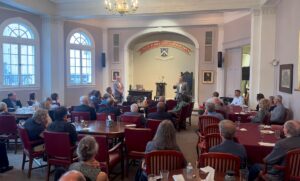 From its opening moments, the event carried significance that went beyond its agenda. Gathering on September 11, a date etched into the American memory, heightened the feeling that the subject matter was not academic abstraction, but part of a larger, urgent conversation about security, resilience, and responsibility.
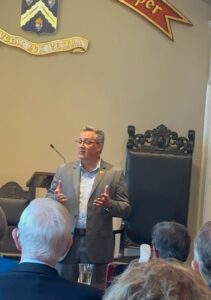 Several elements combined to make the evening truly exceptional. Dr. Harknett’s remarkable depth of expertise brought an uncommon level of insight. He translated complex cyber-strategy concepts into clear, actionable ideas, leaving attendees with both new knowledge and practical ways to think about cybersecurity in their own lives and work. Equally striking was the relevance of his topic. By linking high-level geopolitical cyber warfare to more local concerns such as infrastructure vulnerabilities, cybercrime, and threats to personal data, Dr. Harknett made the global conversation immediately applicable to everyone in the room.
 Richard J. Harknett, PhD is Professor and Director of the Center for Cyber Strategy and Policy at the University of Cincinnati, where he also co-directs the Ohio Cyber Range Institute, a state-wide organization supporting cyber education, workforce, economic, and research development. He is Board Member and Faculty Liaison for the Portman Center for Policy Solutions.

 Since Leon Panetta’s 2012 warning, we have been in an active global cyberwar. Countries, organized crime, hacktivists, and disgruntled employees have caused trillions of dollars of damage.